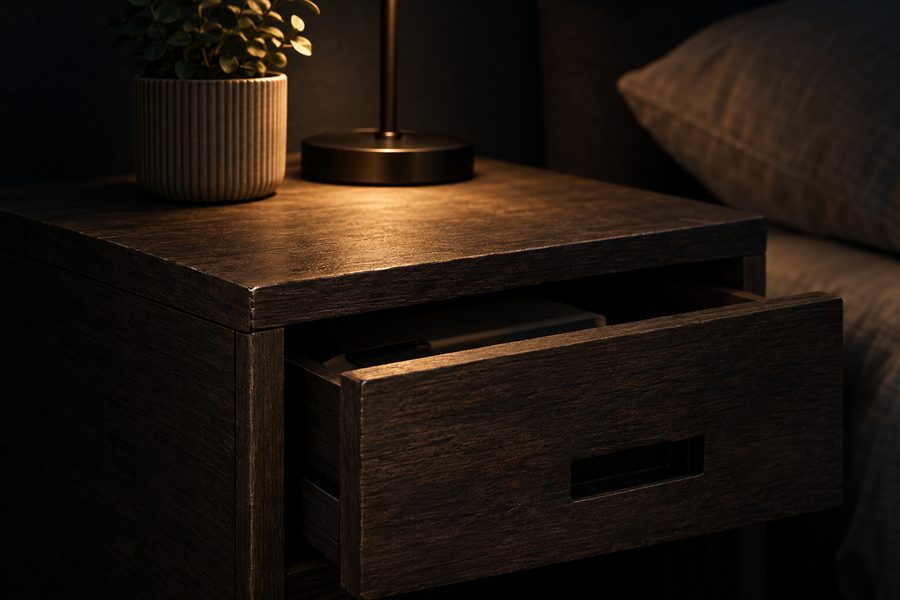
A charging nightstand is furniture bolted to a power supply, and the two halves age at completely different rates. Knowing which part goes first tells you where the money is worth spending.
The ports go first, usually within the first two years
Ports fail mechanically, from cables levering sideways against the internal connections. A port used every night with a cable that leaves at an angle is the most worked part of the whole object.
The warning sign is a plug that needs holding at a particular angle to charge. That is a connection already partly broken, and pressing harder finishes it.
The wireless pad gets fussier rather than failing outright
Pads rarely stop dead. They get less tolerant: a case that used to work starts needing to be positioned exactly, then stops working at all. Heat cycling and dust between the phone and the coil both contribute.
A pad that needs a thinner case after eighteen months is behaving normally for the category.
Drawer runners are the first furniture part to go
On stands with drawers, cheap metal runners develop play, then start dropping the drawer front at the end of its travel. This is a hardware problem rather than a wood problem, and standard runners are a common replacement part.
Soft close runners last longer, mostly because they stop the drawer being slammed.
The case itself usually outlives everything
Even on inexpensive stands, the particle board carcass and the top survive years of normal use. Water rings and heat marks from a mug are the common damage, not structural failure.
This is why the case is the wrong place to spend extra and the plate is the right one.
What this means when you buy
Pay for the power module and the port placement, because those decide whether the stand is still useful in three years. Accept a modest case. Check whether the power module is a standard removable part, because a stand with a replaceable plate has a second life and one with a sealed unit does not.