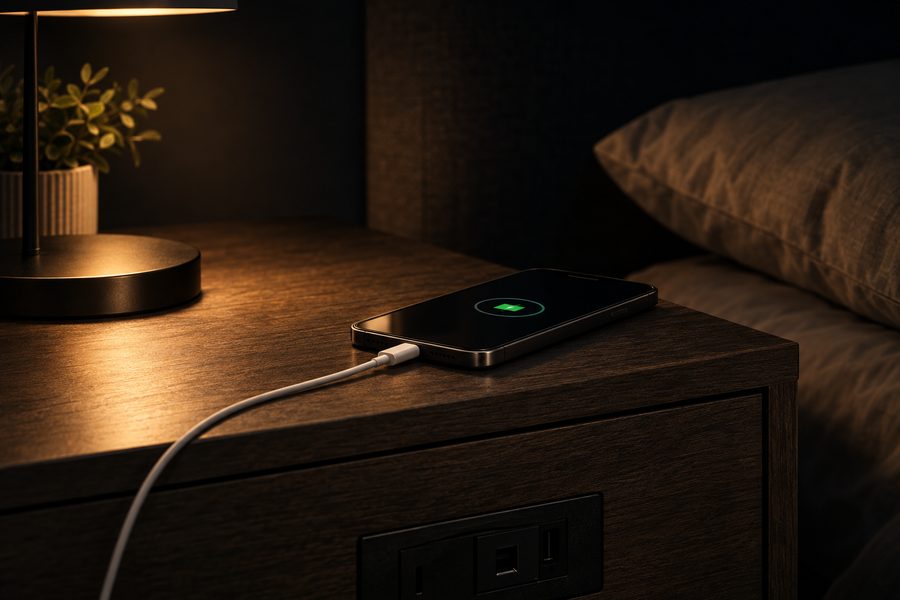
Nearly every charging nightstand offers both a wireless pad and USB ports, and owners end up using one and ignoring the other. Which one you settle on is predictable from how you go to bed.
The pad wins on the act of putting the phone down
Putting a phone on a pad is one motion in the dark. Finding a cable, orienting the plug and pushing it in is three, and the third one fails often enough to be annoying.
If your phone goes down at the end of the night and comes up in the morning, the pad is doing the only thing you need.
The cable wins on everything to do with power
A cable charges faster, does not care about your case, does not need alignment, and does not heat the battery the way induction does. It also still works when the phone is nearly flat and you need it usable in twenty minutes.
The cable is also the only option for a watch, for most earbuds, and for anything that is not a phone.
The pad loses badly on thick cases
This is the split that decides it for many people. A case over about eight millimetres, a metal plate, a magnetic ring or a card pocket will slow the pad down or stop it working.
If you use a wallet case, the pad on a nightstand is close to useless and you should buy for the ports.
The cable loses on clutter, which is the whole point of the furniture
The reason to buy a charging nightstand rather than a power strip is that the cables disappear into the case. A cable coming up over the top edge to reach a phone puts one of them straight back on display.
Stands that route the cable through a notch in the top keep most of that benefit.
How to choose between them
Use the pad if you charge one phone in a thin case and you never need it fast. Use the cables if you charge more than one device, if your case is thick, or if you are ever in a hurry in the morning.
Most people need both, which is why the right question is not pad or cable. It is whether the stand has enough good ports once you stop counting the pad as one of them.