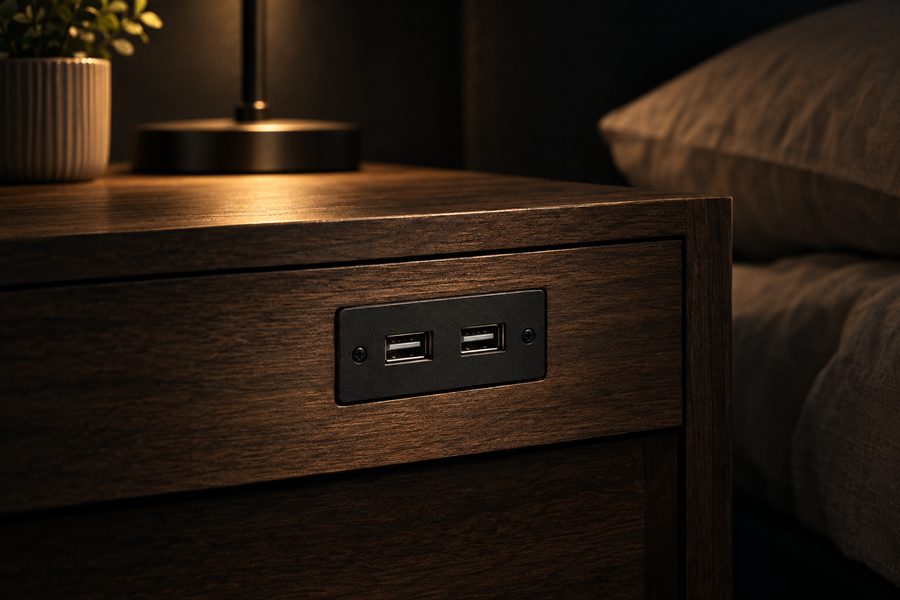
The furniture half of a charging nightstand almost never fails. The power half does, and it concentrates in one place: the USB port. Understanding why changes what you look for in a listing.
The port fails from sideways force, not from electricity
A USB socket is a small metal tongue held by solder joints on a circuit board. Plugging in and out wears it slowly. Levering the plug sideways wears it fast, because the force goes straight into those joints.
Owners in furniture and RV forums describe the same sequence: the cable sits at an angle, the connection gets loose, then it stops charging entirely. One account traces it to cables positioned at ninety degrees breaking the internal contacts.
A nightstand puts the port where the sideways force is
This is the part that makes charging nightstands different from a wall charger. The port is set into the side or back of the case, a few inches from a mattress. The cable cannot leave straight, so it leaves at an angle and rests against something. Every time you roll over and drag the cable, that force arrives at the solder joints.
A wall charger in an exposed outlet does not get this treatment. The same component lasts years there and months in a badly placed nightstand.
Three things in the listing predict it
- Where the plate sits. A plate recessed into a side panel with clearance around it lets a plug sit straight. A plate flush against the back edge, up against a wall or a mattress, forces the bend.
- Whether the plate is replaceable. Some stands use a standard rectangular power module held by two screws. When the port dies you replace a part instead of the furniture.
- Whether the cable route is planned. A notch, a channel or a gap under the top gives the cable somewhere to go. No route means the cable takes the shortest path and loads the port.
What to do with the stand you already own
Use a short right angle cable so the bend happens in the cable instead of at the socket. Leave slack between the port and wherever the cable lands. If a port has gone loose but the others work, stop using that one rather than pushing the plug harder, which finishes the joint.
The failure is visible before you buy
You cannot see solder joints in a product photograph. You can see whether the port has room around it, whether it faces somewhere a cable can actually go, and whether the module looks like a standard part. That is most of the risk, and it is free to check.