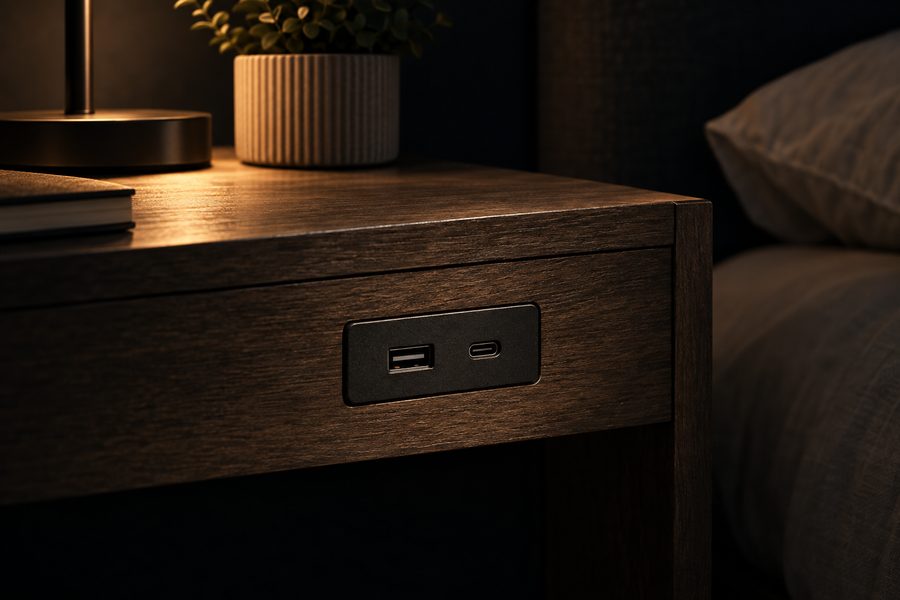
Charging nightstands sit in showrooms and warehouses for a long time, so the port on the plate is often a generation behind the phone in your pocket. The difference is worth understanding before you buy something you keep for a decade.
USB A is the old rectangular port and it is power limited
USB A is the flat rectangle that only goes in one way round. On furniture it usually delivers around five to twelve watts. That is enough to fill a phone across a full night and enough for a watch or earbuds at any time.
What it will not do is fill a nearly empty phone in an hour, and it will not run a laptop at all.
USB C is reversible and carries much more power
USB C is the small oval that goes in either way up. The connector itself supports far higher power, and on a nightstand plate you typically see anything from eighteen watts upward.
The practical differences are speed when you are in a hurry, and the ability to charge a tablet or a small laptop from the same plate.
Overnight, the difference mostly disappears
This is the part the specification sheets obscure. If the phone goes on charge at midnight and comes off at seven, both ports finish the job with hours to spare. Charging speed only decides anything when time is short.
If your phone lives on the stand all night and nothing else needs power fast, USB A costs you very little.
Where USB C actually earns the upgrade
- You charge a tablet or a laptop at the bedside.
- You top the phone up in twenty minutes before going out.
- You want the stand to still be useful in ten years, when USB A cables are harder to find.
The third reason is the strongest one for furniture, because furniture outlives phones.
What to check on the listing
Count the ports by type rather than by total. A plate advertised as four USB ports may be three A and one C. Look for a wattage figure next to the C port specifically, because a C port limited to twelve watts gives you the reversible plug without the speed.
If the listing states no wattage anywhere, assume the lower end.