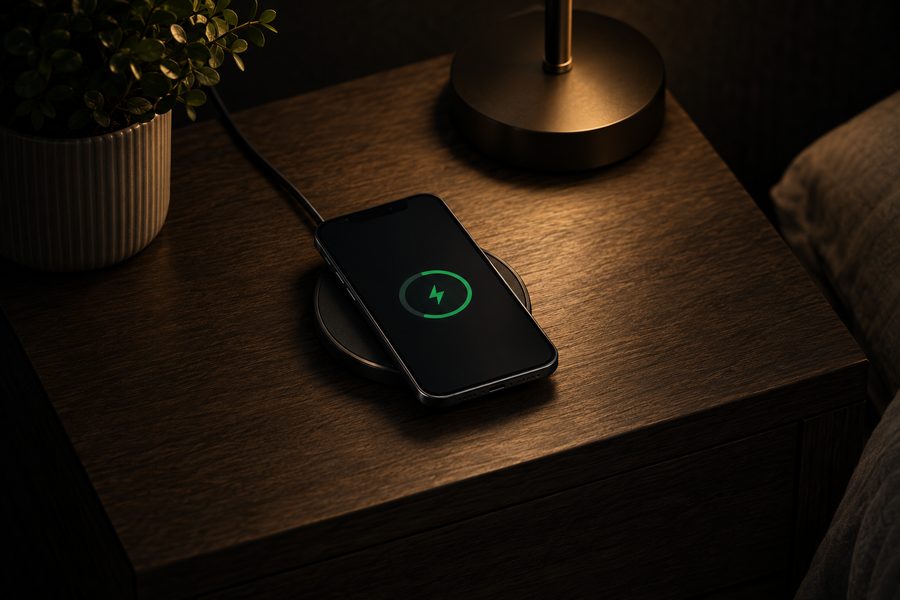
A wireless pad set into a nightstand top looks like the tidiest possible solution to bedside charging. In practice it is the feature owners complain about most. There are four reasons, and they are all predictable.
The case between the phone and the coil is too thick
Wireless charging works by induction across a short gap. The phone case sits in that gap. Cases thicker than about eight millimetres, and any case with a metal plate, a magnet ring or a card pocket, cut the power that gets through or block it entirely.
A card in a wallet case is the worst version, because the card itself absorbs energy and gets warm.
The coils have to line up, and a nightstand makes that hard
The pad has a coil. The phone has a coil. They have to sit roughly on top of each other. On a desk you can see the alignment. At night, half asleep, you put the phone down by feel and land a centimetre off.
Owners describe hunting for a sweet spot that seems to move each time. It is not moving. The phone is landing in a different place, and the pad's tolerance is smaller than the margin of putting something down in the dark.
Heat makes the phone slow itself down on purpose
Induction wastes energy as heat, and a phone lying flat on a pad has nowhere to put it. When the battery gets warm the phone reduces charging speed to protect itself. This is the phone working correctly, and it is why a pad that starts fast finishes slowly.
A pad recessed into a wooden top traps more heat than one sitting in open air.
The charge is finished and you cannot tell
Above roughly eighty percent, phones slow charging deliberately to preserve battery life. Overnight this is invisible and harmless. It also means a pad that looks slow at 3am may simply be doing the right thing.
What actually helps
- Take the case off, or keep a thinner case for overnight use.
- Mark the coil position once, in daylight, with something you can feel in the dark, such as a small ridge or a fabric pad edge.
- Leave air around the pad rather than burying it under a fabric runner.
- Keep one cable on the stand for the nights when the phone is nearly flat and you need it full by morning.
How this changes what to buy
A wireless pad is worth having and is not worth paying much extra for. Buy the stand for its ports, its spacing and its surface, and treat a working pad as a bonus that handles the easy nights.