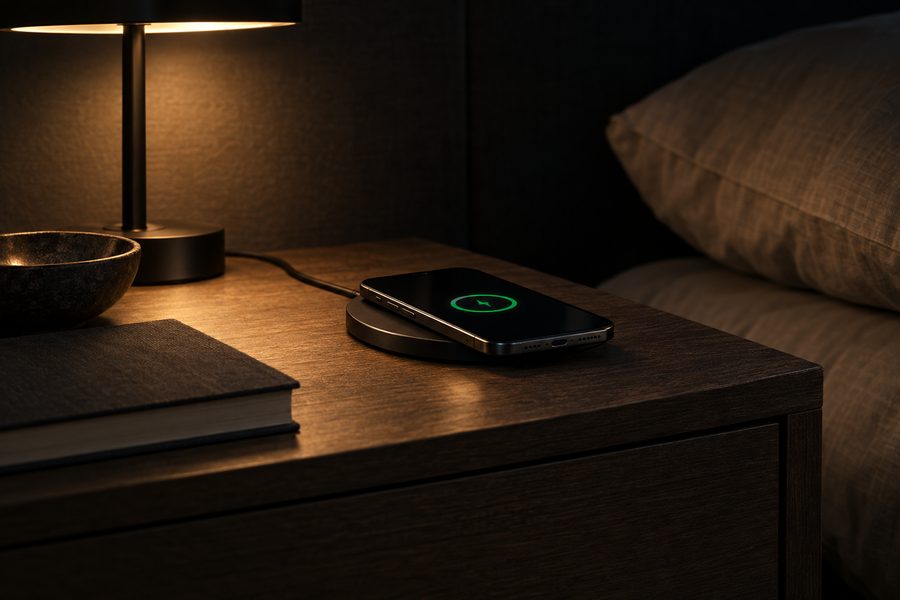
Every charging nightstand listing shows the same photograph of a phone glowing on a wooden top. The differences that matter are not in the photograph. Answer these six questions in order and most of the market drops away.
Count what you charge overnight, then add one
Walk to your bed and count what needs power by morning. A phone is one. A phone and a watch is two. Add earbuds and you are at three, and three is where most stands run out.
Add one to your count. The spare port is what absorbs a guest, a new device or a battery pack, and it costs nothing to specify up front.
Check that the ports are spaced, not just counted
Four ports in a row an inch apart hold four thin cables or two thick plugs. A charger with a wide housing covers its neighbour. If the listing shows the plate close up, look at the gaps. If it does not show the plate close up, that is itself worth noticing.
Decide whether you need a wall socket or only USB
USB ports charge phones, watches and earbuds. A wall socket runs a lamp, a fan, a CPAP machine or a laptop charger. Stands come with either or both.
If a lamp already lives on the nightstand, you need at least one socket, or you need the lamp to keep its own cable to the wall.
Treat the wireless pad as a bonus, not a reason
Wireless pads are the headline feature and the most common disappointment. They charge slower than a cable, they refuse thick cases, and they need the phone placed on a specific spot that is hard to find in the dark.
A pad is a nice addition to a stand with good ports. It does not make up for bad ones.
Measure the top surface that is left
A nightstand also holds a lamp, a book, a glass of water and whatever you empty out of your pockets. A wireless pad set into the top removes usable area, and so does a raised edge.
Measure the space your current nightstand actually uses, then check the stand you are considering has that much left after the charging hardware.
Find out how the power gets in
Every charging nightstand ends in one plug that has to reach a wall outlet. The cord length decides whether the stand can sit where you want it.
Check the length, and check which side it leaves from. A cord that exits the wrong side crosses the floor or forces the stand to face the wrong way.
The order matters
Ports and spacing are structural and cannot be fixed later. A wireless pad, drawer layout and finish are preferences. Settle the first three questions, and whatever survives is a genuine shortlist rather than a search results page.