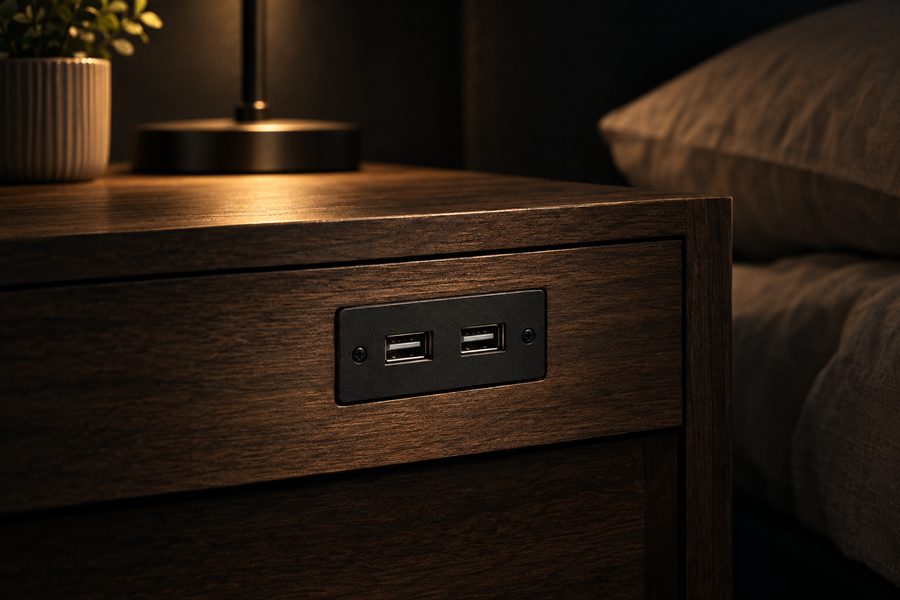
Search this category and every result leads with a number of ports. Port count is the easiest thing to print and close to the least useful thing to know. Three other things decide whether a USB nightstand works.
Total power is shared, so count watts before ports
A charging plate has one power supply feeding all its ports. A plate rated at eighteen watts total does not give eighteen watts to each of four ports. It splits what it has.
Four ports on a low total means four slow charges. Two ports on a generous total means two fast ones. Find the total figure, then divide by how many things you plug in on a normal night.
Spacing decides how many ports you can really use
Ports an inch apart fit thin cables. They do not fit two wide plugs side by side, and a single chunky charger head can cover its neighbour entirely.
Look for a close photograph of the plate. Measure the gaps against the port width, which is a known size. If no close photograph exists, treat the usable port count as lower than the advertised one.
Placement decides how long the ports last
Ports fail from sideways force on the plug, and placement controls how much of that force they get. A plate with clearance around it, facing outward, lets a plug sit straight. A plate crammed against the back edge next to a mattress forces every cable into a bend.
This is covered in full in the piece on why the ports fail first, and it is the single best predictor of whether the stand still charges in three years.
Mixed port types are a hidden limit
A plate advertised as four USB may be three of the old rectangular type and one reversible. If everything you own now uses the reversible plug, you effectively bought a one port nightstand with three adapters worth of inconvenience.
Count by type, not by total.
A wall socket changes what the stand can do
USB ports charge small devices. A wall socket runs a lamp, a fan or a laptop charger. If a lamp already lives on the nightstand and you want its cable to stop crossing the floor, you need at least one socket on the plate.
The order to judge them in
Total power, then spacing, then placement, then port types, then socket count. Anything that clears all five is worth the price difference over a plain nightstand and a power strip.